Tokenomics
MAGNE.AI Tokenomics
Overview
| Property | Details |
|---|---|
| Token Name | MHA |
| Total Supply | 10,000,000,000 MHA |
| Decimals | 18 |
MHA is the native token of the MAGNE Layer1 blockchain. It serves as gas for transactions, staking collateral for validator security, and a base currency for governance and ecosystem incentives via PoL. mBGT is the utility and governance token used to coordinate validator emissions and participate in protocol-level voting.
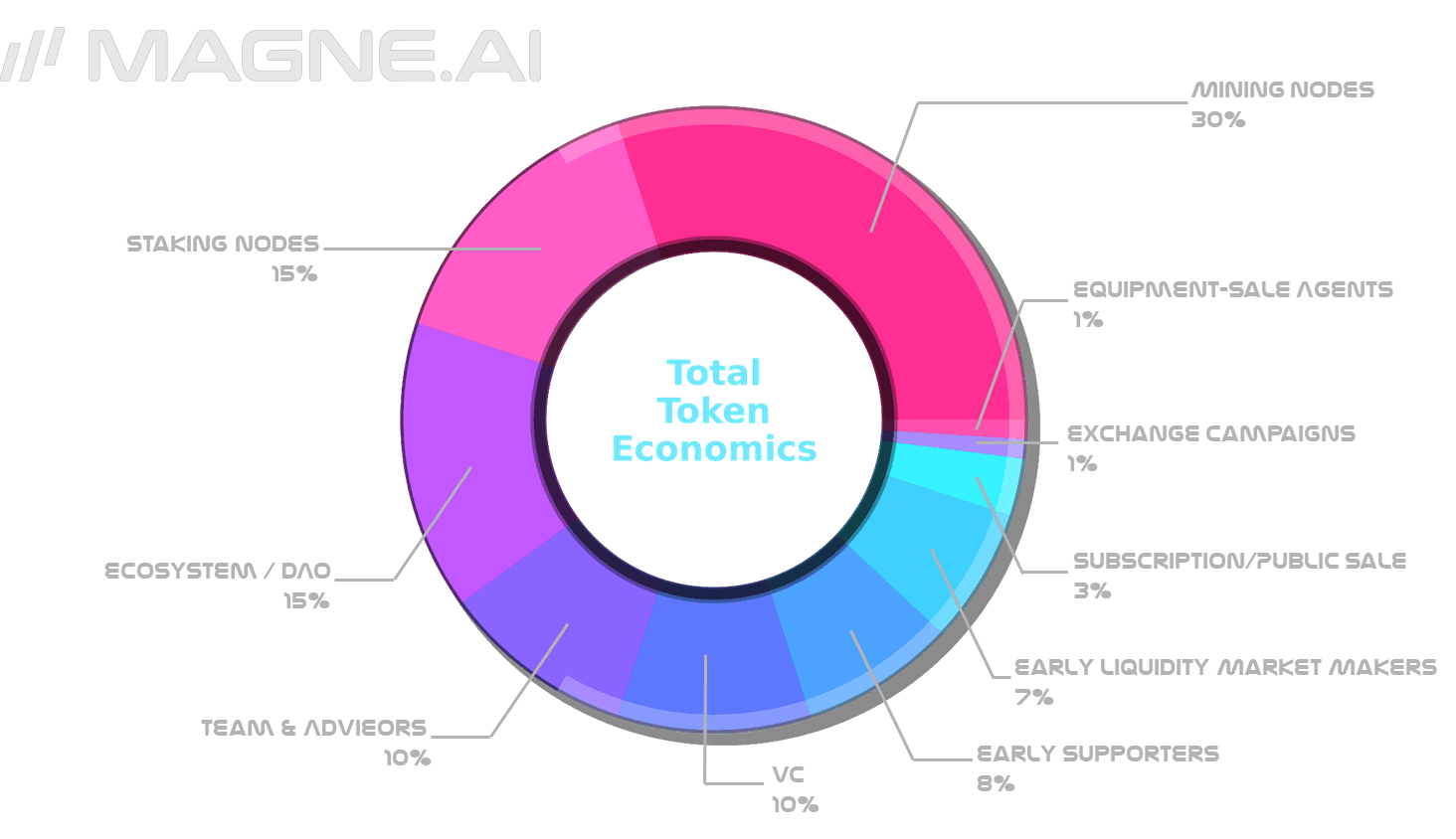
The 10 billion MHA supply is allocated as follows
| The 10 billion MHA supply is allocated as follows | Details | % |
|---|---|---|
| Mining Nodes | 3,000,000,000 MHA | 30% |
| Staking Nodes | 1,500,000,000 MHA | 15% |
| Ecosystem/DAO | 1,500,000,000 MHA | 15% |
| Team & Advisors | 1,000,000,000 MHA | 10% |
| VC | 1,000,000,000 MHA | 10% |
| Early Supporters | 800,000,000 MHA | 8% |
| Early Liquidity Market Makers | 700,000,000 MHA | 7% |
| Subscription/Public Sale | 300,000,000 MHA | 3% |
| Equipment-Sale Agents | 100,000,000 MHA | 1% |
| Exchange Campaigns | 100,000,000 MHA | 1% |
Mining Nodes
Refers to nodes that obtain token rewards by providing valid workloads across various scenarios, including PoAI/DePIN computation, bandwidth provisioning, and distributed storage. Rewards are typically settled based on overall contribution score, which factors in compute power, throughput, uptime, and quality metrics.
1. Objective
-
Objective:
Without altering the 10-billion token allocation or the Mining = 30% (3,000,000,000 MHA) distribution, establish an auditable, governable, and scalable issuance mechanism for device-based incentives.
-
Scope:
At this stage, only the MAGNE.AI Phone GEN1 (8 TOPS) is activated.
The remaining hardware devices are reserved for future activation, pending mass-production readiness and fulfillment of governance requirements
2. Sub-pool Structure
-
Sub-pool-1: MAGNE.AI Phone GEN1 (8 TOPS)
-
Ceiling = 400,000,000 MHA (400 million) (Note: Ceiling ≠ Guaranteed Full Allocation; unused tokens will flow back into the mining pool or the next epoch)
-
Issuance Curve: Halving annually, with the first-year allocation set at 200,000,000 MHA, distributed equally on a monthly basis.
-
Initial Market Stabilization (First Quarter):
Year 1: M1 = 20%, M2 = 60%, M3–M12 = 100%
-
-
Sub-pool-2: TBD
-
Sub-pool-3: TBD
-
Sub-pool-4: TBD
Design Principle: All sub-pools are based on ceiling allocations, not a commitment to fully distribute. Rewards are settled based on valid workloads during each period. Unallocated tokens will automatically revert back to the mining pool or the next epoch, avoiding passive earnings and preventing early-stage hyperinflation
3. Budget & Allocation Core Formulas (Applicable to All Sub-pools)
3.1 Current Year Budget (Example: MAGNE.AI Phone GEN1)
- Annual Allocation (Halved Yearly):
- Monthly Base Ceiling for the Year:
- Initial Year Smoothing (Applicable Only to Year 1, M1–M3):
Handling Unallocated Tokens: Any unspent portions from M1 and M2 within Q1 will revert back to the main pool.
3.2 Valid Workload (ECU) & Time-Weighted Distribution
-
ECU Definition (Prevents raw TOPS from dominating the calculation):
(MAGNE.AI Phone Gen1 does not use efficiency factor yet)(MAGNE.AI Phone Gen1) -
Online Time Differentiation (Time-Weighted Calculation):
-
Current Period Reward Allocation:
This ensures that machines which are online early, remain online longer, and have higher quality earn more rewards. Machines that go online later or mid-period will only earn rewards for the valid time period they were active.
3.3 Distribution Splits & Locking Mechanisms
-
Basic Split:
40% immediately available + 60% linear over 3 months.
-
Voluntary Locking → Weighted for Next Period (No additional issuance, only redistribution):
-
6/9/12-month voluntary locking, with respective ECU weight increases for the next settlement period:
+10% / +15% / +20%.
-
-
Circulation Inclusion:
Only the immediately available portion and the unlocked portion are included in the circulating supply. The locked portion is considered Allocated (non-circulating).
4. Sub-pool-1: Initial Year Smoothing & Value Table
-
First Year Annual Allocation:
-
Monthly Base Ceiling:
| Month | Smoothing Factor | Monthly Ceiling (MHA) |
|---|---|---|
| M1 | 20% | 3,333,333.33 |
| M2 | 60% | 10,000,000.00 |
| M3–M12 | 100% | 16,666,666.67 |
Execution Recommendation: Unspent portions from M1/M2 will flow back to the main pool.
Combined with the 40% immediately available and 60% over 3 months linear split, this smooths out early-stage selling pressure.
5. Entry Thresholds, SLA, and Penalties (Slash)
-
Minimum Entry Requirements:
Registration and remote authentication (hardware fingerprint/firmware signature); KYC is optional (toggleable setting).
-
Activity Threshold:
To qualify for allocation, the node must meet the following criteria:
Monthly Uptime ≥ 240 hours, Uptime ≥ 95%, and Quality ≥ 98%.
-
**Extended Offline Periods:**Reward=Uptime0.5×Uptime0.5×Uptime0.5
Rewards for the current period will be reduced based on the formula:
Repeated offenses will lead to downgrading to an observation list for monitoring.
-
Malicious Behavior/Falsification:
Rewards for the current period will be zeroed out, with penalties prioritized from "unlocked balance"; historical recovery efforts will be made, and the entity will be blacklisted for 3–12 months.
-
Anti-Sybil Protection:
Multiple devices from the same entity/ASN will be merged for weighting; device fingerprints will be deduplicated; geographical and operator diversity will be weighted to prevent centralized manipulation.
-
Self-Staking (Optional):
Operators may stake a small amount of MHA to earn a 1.05–1.15x reward multiplier. Violations will result in Slashing
6. Governance & Parameter Changes
-
Governable Parameters:
first-quarter smoothing factors, split ratios, locking durations, activity and quality thresholds, quarterly rollover models, etc. -
Process:
Proposal → Voting Approval → 48–72h Time Lock → Contract Parameter Update.
-
Risk Anchor Points:
The net circulating supply increase in the first 24 months should not exceed 0.8% per month. Significant changes must be evaluated for their impact on this metric.
7. Dashboard & Public Disclosure
-
On-Chain Transparency:
Sub-pool contract addresses, monthly caps, actual distribution, locked balances, and unlocked balances.
-
Operational Data:
Number of active devices, geographical/ASN distribution, average uptime/quality, blacklist and slash records.
-
Transparency:
Quarterly reports (unused tokens reverted, parameter adjustments, risk management events).
Staking Nodes
Staking nodes participate in network security and consensus by staking MHA to validate blocks and vote. Rewards are distributed based on staking amount × uptime/performance. Delegators can delegate their tokens to validators to share in the rewards.
Ecosystem / DAO Treasury
Allocated for developer grants, ecosystem partnerships, hackathons, community budgets, and other ecosystem-driven initiatives, subject to DAO proposal approval and milestone-based disbursements. Unmet milestones will revert back to the treasury.
Annual disbursements will not exceed 10% of the total supply.
Implementation Method:
48-month linear release + multi-signature approval + time lock + quarterly transparency reports.
Team & Advisors
Allocated for long-term incentives for core team members and advisor compensation.
Implementation Method:
18-month cliff followed by 120-month linear vesting.
Clawback provision applies in case of resignation or failure to meet performance goals, allowing unvested tokens to be reclaimed.
VC (Investors, Institutional/Private Round)
Allocated for early-stage contributions from institutional investors or qualified investors.
Implementation Method:
12-month cliff followed by 24-month linear vesting.
Early Supporters
Allocated for individuals or groups who were the earliest to engage in community building, beta testing, content contribution, and node setup.
Implementation Method:
6-month cliff, followed by 1/6 release in the 7th month, and the remaining 5/6 vesting over 24 months.
Introduce Proof of Contribution (PoC) to prevent "airdrop hunters" and ensure rewards are tied to actual contributions.
Early Liquidity Market Makers
Allocated for providing buy/sell depth and price spread management on CEX/DEX platforms (typically placed in LP positions or market-making accounts).
Implementation Method:
LP lockup for ≥ 12 months.
Market-making terms are made public (including minimum depth, maximum spread, and replenishment rules).
Many teams do not consider LP tokens as circulating supply until they are unlocked.
Subscription / Public Sale(3%)
Tokens allocated for public sale to a wider user base (e.g., Launchpad, subscription, or whitelist-based public offering).
Public Sale Intro
According to the MHA tokenomics, 3% of the total supply is allocated to public sales, which will be completed before listing. All tokens purchased during this period will be listed on global top-10 centralized exchanges. After the listing, these tokens will be locked for six months, with linear vesting beginning in the seventh month.
The current public sale is being conducted on the BSC chain and will later be mapped to the MHA chain.
- Public Sale OG (1%): Prior to the listing, an early-supporter public sale will be conducted at the lowest public-sale price; at the time of listing the token price will not be below this level. Tokens will be locked for six months after listing and then released continuously over twenty-four months.
- **KOL/ECO Sale (0.5%):**The public sale for KOLs and ecosystem partners will be priced higher than the Public Sale OG. Tokens will be locked for six months after listing and then released continuously over twenty-four months.
- **Public Sale Session 1 (1.5%):**The formal pre-sale will be open to the public worldwide at a price higher than that of the Public Sale OG. Tokens will be locked for six months after listing and then released continuously over twenty-four months.
| Dimension | Typical Practice for Public Sale OG | Differences with Regular Public Sale |
|---|---|---|
| Target Audience | Genesis NFT holders, testnet interaction addresses, early Discord roles, Genesis device buyers, and other on-chain verifiable OG addresses | No entry barriers; open to anyone for participation. |
| Price | Lowest price across all sales, below future pre-sale, public sale, or exchange launch prices | Higher than OG, but lower than or equal to initial market price. |
| Allocation | Very low individual hard cap (e.g., 50–200 USD/address), focused on wide distribution | Higher hard cap, with a focus on raising significant funds. |
| Lock-up | Typically, a portion unlocked at TGE, with the remainder released linearly over 3–18 months, or fully locked for 6 months before linear release | May unlock 20-50% at TGE. |
| Marketing Positioning | “Community reward”, “early bird honor”, emphasizing identity recognition | Focus on “investment opportunity” and “public fundraising”. |
Implementation Method:
6-month cliff, followed by 1/6 release in the 7th month, with the remaining 5/6 vesting over 24 months.
KYC/compliance checks will be conducted.
Mechanisms will be in place to avoid price discrepancies with private sale.
Equipment-Sale Agents
Tokens allocated for distributor/channel incentives related to your hardware ecosystem (e.g., MAGNE.AI Phone, PoAI Station), using token discounts or rebates to incentivize sales.
Implementation Method:
3-month cliff, followed by 24-month linear vesting.
Incentives are tied to actual sales/revenue.
MHA locking can be required for higher rebate percentages.
Exchange Campaigns
Allocated for exchange launch campaigns, including activities such as deposit/trading competitions, staking subscription, and task-based rewards.
Implementation Method:
1–12 months installment release.
Strong whitelist requirements and anti-Sybil protections.
Unused tokens after the campaign will either revert back to the treasury or be burned.